



Working Principle:
In the in-situ treatment method, the aerated tube well water is stored in feed water tanks and released back into the aquifers through the tube well by opening a valve in a pipe connecting the water tank to the tube well pipe under the pump head. The dissolved oxygen in aerated water oxidizes arsenite to less-mobile arsenate, the ferrous iron to ferric iron and Manganese(II) to Manganese(III), followed by adsorption of arsenate on Fe(III) and manganese(III) resulting in a reduction of the arsenic content in tube well water. Oxidation is further enhanced biologically by bacteria living in the subsurface and is termed bioremediation process. Because of the input of oxygen, the redox potential of the water is increased. A number of different physical, chemical and biological processes are intensified in the surrounding area of the well screen section, the so called oxidation zone. The alternate operation of the wells for delivering groundwater in the tank top and infiltration of the oxygen rich water into the aquifer induces alternating oxidation and adsorption periods on the surface of the solid material in the aquifer.
The process of in-situ oxidation of groundwater virtually transfers the oxidation and filtration process of the conventional above ground water treatment plants into the aquifer. The underground aquifer is used as a natural biochemical reactor.
The in situ method is a very cost effective and eco-friendly process for arsenic removal. The greatest advantage of this process is there is no need for sludge handling. The arsenic which is trapped into the sand along with the iron flocs constitute a infinitesimal volume of the total volume being handled and hence pose very little environmental threat in its adsorbed form. The whole mass remains down below unlike other processes where there is extra cost of sludge handling and messy disposal problem. The process is chemical free, simple and easy to handle. There is no restriction to the volume it can handle as long as proper time is allowed for the oxygen rich impregnated water to create the adequate oxidizing zone in the deep aquifer. It is also quite flexible with respect to the raw water quality as the efficient coefficient could be varied depending on the quality of the raw water. It involves low capital cost and minimum operating cost . The results obtained in the test site is quite promising as the process is able to reduce the arsenic content from 100-250 mg/l to permissible limit. It is ideal for a rural set up where people really cannot afford to pay a substantial amount for water supply. The only disadvantage is that it takes some time for the whole system to stabilise because of the slow kinetics of the oxidation process. However, once stabilised, it remains steady for years to come.
On the other hand, uncalculated amount of oxidation of the aquifer can really mess up the system resulting in As and Fe precipitation rather than adsorption (resulting in As release in later date). Also, the abrupt change in redox potential and huge oxidation may destroy the existing bacterial population, making the whole process unstable and ineffective.
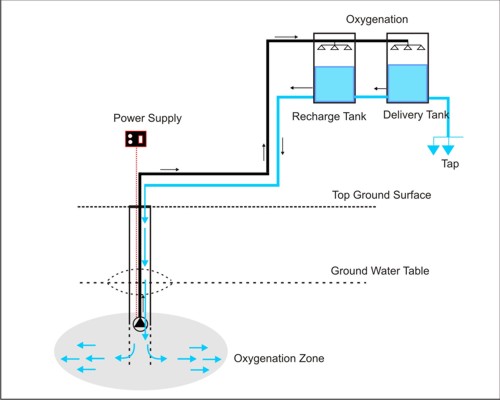













A schematic diagram of a SAR plant
Designed by: Soumyadeep Mukhopadhyay
Site owned by: Bhaskar Sengupta, OBE